Fuck, Online. An Analysis of Online Pornography Use
Research Paper for Steffani Dambruch
Note: If you or a friend is struggling with this topic I would advise this website https://easypeasymethod.org and to seek help wherever available.
This is a qualitative research paper that attempts neutral in its analysis and is meant to add to the literature. Most of my literature review was based off of the systematic review of ‘de Alarcón, Rubén, et al.’ and the primary sources listed in that paper.
Introduction
Pornography is a billion dollar industry. Pornography is a form of media (be it written, images, or videos) in which the primary purpose is to cause sexual arousal. With the surge in internet use across the world pornographic content has never been more accessible. Yet even with the sexual revolution of the 1960s era, pornography is still prominently of conversational taboo. With many sites including Xvideos, Xnxx, Xhamster, and Pornhub being among the most top visited sites in the world, there is a dissonance between what people do not talk about and what they do. This paper looks into: What is the backstory behind pornography users and what are the individual perceived effects of general pornography use?
Review of Literature
This literature review explores studies that examine the prevalence, effects, addiction, and treatment of online pornography use. In 2017 Pornhub published a compilation of their yearly usage data which stated: “we did a lot of hosting this year, catering to some 28.5 billion visitors, which turns out to be an average of 81 million people per day!” (2017 Year in Review - Pornhub Insights). This overview from Pornhub also gives a detailed analysis of overall pornography viewer demographics for year over year data. One oversight of the data, however, is that it only pertains to individuals that are actively going to the site. To make up for this, Solano et al. found that “Using all modalities of pornography, 91.5% of men and 60.2% of women herein reported having consumed pornography in the past month” with “the primary function of enhance[ing] masturbation” (92). With this statistically significant result it must be asked - by what degree does this consumption leak over to adolescent use? Quadara et al. from their sample found that “Fifty-three per cent of those surveyed had seen online pornography at least once-of which 94% reported viewing online pornography before the age of 14” (37). This means that a substantial amount of kids are seeing sexually explicit content before sexual development or education. Donevan et al. shows that this early exposure can have a substantial compounding effect: “The share of boys who use pornography frequently increased over the three survey cycles; those who reported using pornography daily increased from 11% in 2004 to 24% in 2014.” (1125). Interestingly, “there was no change in girls who reported using pornography daily, while the proportion who never used pornography increased from 40% in 2004 to 51% in 2014” (1125). The data collected helps to explain why Pornhub has a seventy to thirty percent split of male to female viewers (2021 Year in Review - Pornhub Insights). The prevalence of pornography within different researcher’s samples gives good justification for pornography to be looked into further.
The substantial usage also then begs the question of its effects. The medium of pornography is sexual in nature and might have inadvertent effects outside of self pleasure. Perry and Davis go into how pornography might have an effect on romantic relationships. They saw that “Americans who viewed pornography at all in 2006 were nearly twice as likely as those who never viewed pornography to report experiencing a romantic breakup by 2012, even after controlling for relevant factors such as 2006 relationship status and other sociodemographic correlates” (1157). These results backup that of Manning which looked into marriage; A bond usually seen as more stable than non-binding relationships. Manning found “married women to be significantly more distressed by a partner’s online pornography consumption than women in dating relationships, and that Internet pornography consumption is viewed as a threat to the relationship” (140). However, the use of pornography may not be the underlying reason for relationship instability. This is because Bőthe et al. found that among their sample “Males and females did not differ on relationship status” (112). Contrary to the assumption that more males would be single due to their predominant use.
Pornography however, might also impact other areas besides interpersonal relationship. Perry and Snawder looking into child relationship quality (how well parents and children get along with each other) noted “that greater pornography viewing predicted negative outcomes on two out of four measures of parent-child relationship quality” (1747). They also dug further into the issue showing that “the negative association between porn viewing frequency and three parent-child relationship outcomes was stronger for participants who attended religious services more often” (1747). This could possibly have devastating effects for familial bonds going into the future. This means that pornography is impacting subordinate relationship (parent-child) as well as mutual relationships (partner-partner).
It is also important to see if pornography use has any other long term effects besides parent-child relationship quality. To explore a tangential topic DeKeseredy and Corsianos looked into how “men enter[ed] the experimental labs with relatively good attitudes toward women. They [then] watch[ed] a sexually graphic and violent video, and then are shown to have more troublesome attitudes toward women” (58). With the underlying problem of that “this is not the first time these men have ever been exposed to pornographic media” (58). So, it is unknown how much of a factor pornography plays in abusive relationships.
One of the more immediate correlations that has been studied is pornography’s effect on sexual health. Bőthe et al. looked into how “PPU (Problematic Pornography Usage) was moderately and positively related to sexual functioning problems” (112). With the conclusion of “Given that PPU was positively and moderately and FPU negatively and weakly associated with problems in sexual functioning, it is important to consider both PPU and FPU in relation to sexual functioning problems” (112). This could mean that only troublesome use of pornography could have negative sexual effects, independent of how often someone consumes the content.
With this in mind it would be more important to focus on specifically Problematic Online Pornography Use (POPU) rather than online pornography as a whole. Two main causes are pointed to POPU: to reduce anxiety or behavioral addiction. A consensus on the issue has not been made: “Coleman has considered hypersexuality to be driven by the need to reduce some type of anxiety, not by sexual desire having classified it in seven subtypes (one of them being use of online pornography), while Carnes (who defined addiction as “a pathological relationship with a mood altering experience”) finds similitudes to other behavioral addictions like gambling, focusing on the loss of control and continued behavior despite negative consequences” (de Alarcón et al. 6). Further, “[while] self-perceived pornography addiction, has increasingly emerged as a topic in scientific research, despite lacking formal recognition as a disorder and continued disagreements about its definition, or even existence” (Sniewski et al. 218).
Since research into the topic of POPU and SPPPU (Self-Perceived Problematic Porn Use) is undecided, it might be better to see how current notions of the addiction are being treated. One way there has been success is through the use of structural therapy. A married couple on the brink of breakup restructured their relationship in a way in which the male partner had to ask his female partner for permission to use pornography. Eventually, the male partner threw out all of his pornographic stash. The therapist technique was to address the underlying issue of pornography addiction before trying to fix the relationship (Ford et al.). This helps to give some idea of how POPU is a reason for relationship instability.
On a pharmacological basis Gola and Potenza experimented with paroxetine as a probable treatment to pornography addiction. They found that while “Paroxetine may hold promise for short-term reduction of PPU and related anxiety, new potentially distressing sexual behaviors may emerge” (529). With the odd phenomena that “all of the new sexual behaviors had a dyadic characteristic and were not accompanied with rebound of pornography use and masturbation” (530). This might give clues as to an underlying psychological behavior that led to the addiction and not exactly pornography as the main problem.
Finally, the method of Acceptance and Commitment Therapy was explored as a treatment for pornography addition. Acceptance and Commitment Therapy is a regiment of therapy with different exercises to help a person limit problematic use of pornography. With a small sample size they found promising results with an 85% reduction in viewing and a 83% reduction after a 3 month follow-up (Twohig and Crosby). Giving much interest into seeing larger sample sizes being treated with this method while also providing more evidence to pornography use being due to psychological behavior.
**Proposal and Methods
**The general overview of online pornography and its related topic of problematic online pornography use leaves much to be desired. With little consensus and small sample sizes, much of the research done into the topic of treatment leaves more to be retested and confirmed. The conversation for POPU’s underlying psychology and neurology also needs to be further explored to get a better understanding of the issue. With pornography’s large presence within society, further research is needed for understanding its impact on individuals and how to treat those severely affected.
While effects of online pornography use have been explored the research could also use work. Many studies were focused on interpersonal relationships such as marriage, partnerships, and parent/child connections. Each concluding about the general negative effects of pornography use for ruining those connections. Other areas looked into those such as sexual function. A study found that only Problematic Online Pornography Usage was more associated with sexual health than Frequent Pornography Usage. The final area of literature looked into was how pornography viewing might negatively effect perceptions men have towards women after watching it. Overall, the studies leaned toward a negative view of pornography but in some cases has it as a connection rather than the cause (such as in the case of abusive relationships). With the area of Problematic Online Pornography Usage the main response behind the addiction has multiple theories. Two of the main theories being to reduce anxiety or Problematic Online Pornography Use being the result of a behavioral addiction. With no definitive definition of pornography addiction within the Diagnostic and Statistical Manual of Mental Disorders (DSM-5) there are no clear examples for what exactly constitutes this behavior as a problem.
Lastly, treatment into pornography has had two different areas studied: a pharmacological and psychological approach. Within the pharmacological study, Paroxetine has shown the ability to curve online pornography use but had the side effect of the individuals transferring to other hyper sexual behavior. On the psychological approach acceptance and commitment theory showed promising results with an 83% reduction in pornography viewing after 3 months.
In this vein less has been explored about the positive or possible beneficial uses for pornography. This may either be a result of certain demographics not being looked into or there is less application of a positive use. There has been little consensus on the effects of pornography due to the fact that pornography may not be the only behavior effecting the individual (such as in cases of sexual dysfunction). Many of the samples within niche research are too small to make conclusions to the population. As well, little consensus has been reached on the definition for addiction or Problematic Pornography Usage. In the area of treatment, little has been explored for pornography addiction. Leaving a wide gap for those looking for help and clinics unable to give proper care due to this lack of research.
One area where research is sustainability falling short is in the area of first hand reports of pornography users. While prevalence is well know through multiple studies there is little to show for the stories behind pornography users other than demographic data.
The voices of pornography users has been substantially lacking within current research. While some studies have directly quoted participants there have been few dedicated inquiries into the overarching story of how someone comes to use the medium. The researcher wants to understand: What are the individual perceived effects of general pornography use? This will be with the understanding of getting individuals stories and their background. This research will be in the form of a case study following the guidelines of similar research on the behavior of Youtube use. The aforementioned study is important because Youtube is a very similar medium in which most of pornography is consumed, through videos. New areas of study that will be looked into will include other areas of behavioral addiction and habit formation. The researcher predicts that the perceived effects on general pornography use will vary by individual and their background. While there might be differences in what got these people to use pornography, there will most likely be similar characteristics for continued use. There will be two predominant areas of limitations within the research. One will be the limitation of the sample size since there will be few people found to interview for this research. The second will be the use of qualitative measures for data collection and analysis. Since the people being interviewed may have substantially different backgrounds, it will be up to discretion to find similarities and differences. The form of self-perception is an inherent limitation with the study to be carried out.
A previous assessment into Youtube video consumption by Klobas et al. laid out the ground works for different types of behavioral viewing. Within their paper they separated Youtube use into addicted, compulsive, and functional avenues. The researcher’s goal within this paper is to see if those distinctions can be made on pornography users. The second goal within this paper is to get fuller stories of different pornography users. Having their background and development helping to tell their story of pornography use.
The following questions were used to collect data as well as to get short open-response answers from the participants. Appropriate follow up questions were asked if participants delved further into a specific topic.
- What is you sexual orientation, age, and demographic?
- Is there a specific site that is frequented more often to watch pornography?
- When was the first time you watched pornography?
- How often would you say you consume pornography in a week?
- Do you think that pornography has affected your sex life?
- Do you perceive your pornography use to be a problem?
- Have you watched pornography other than masturbation purposes?
- Have you visited pornography because you were bored?
- Do you want to change your pornography use?
- Has pornography use affect your relationship quality with you parents?
- Have you visited pornography for informational reasons?
The participants were also asked to complete a Short Form Pornography Consumption Effects Scale (PCES-SF) from Miller et al. to be used as cross-correlate data and not intended for direct interpretation.
- 1. SL (P) Overall, has improved your sex life?
- 2. LG (N) Has made your life more problematic?
- 3. PATOG (P) Has made you more respectful towards the opposite gender?
- 4. SL (N) Overall, has made your sex life worse?
- 5. ATS (N) Has had a negative influence on your attitudes toward sex?
- 6. SK (P) Has improved your knowledge of oral sex?
- 7. LG (P) Has improved your quality of life?
- 8. ATS (P) Has had a positive influence on your attitudes toward sex?
- 9. SL (P) Has added something positive to your sex life?
- 10. PATOG (N) Has led you to view the opposite gender more stereotypically?
- 11. ATS (N) Has adversely influenced your opinions of sex?
- 12. SK (P) Has improved your knowledge of sex?
- 13. ATS (P) Has positively influenced your opinions of sex?
- 14. SL (N) Has added something negative to your sex life?
Note. SL sex life; LG life in general; ATS attitudes toward sex; PATOG perception of and attitudes toward the opposite gender; SK sexual knowledge. (P) indicates that the item relates to the positive effect dimension. (N) indicates that the item relates to the negative effect dimension. All items are on a 7-point scale: 1 not at all; 2 to a very small extent; 3 to a small extent; 4 to a moderate extent; 5 to a large extent; 6 to a very large extent; and 7 to an extremely large extent. Effect dimension totals and subscale totals are calculated by averaging the items contributing to the dimension or subscale (Miller et al. 476).
Results
The study focused on three individual male teenagers (19 years old) with varying life experiences. A summary of each individual is described below.
Participant G - Compulsive Use (Jamal)
Jamal is a Caucasian male who has a bisexual preference. The site frequented most often by Jamal was that of the site Xvideos. Jamal’s first time watching pornography was when he was twelve years of age. Throughout the week, Jamal consumes pornography around three to five times. Jamal has shown a common occurrence of compulsive use for a few reasons. Firstly, Jamal says on two separate occasions that it has negatively affected him personally. He first notes that pornography has a negative effect because “it made it difficult [to get an erection] for my previous ex[-relationship] if she wanted to have sex”. Secondly, Jamal mentioned that he perceives his pornography use to be a problem because it “gives me problems getting aroused”.
Interestingly, Jamal notes that “I perceive [my use] to be a problem because I’ve been raised Christian my whole life, I feel especially guilty watching the homosexual films, though I try to ignore it”. This is to say that his compulsion to watch pornography is greater than the negative physical and psychological effect. He further shows that “pornography hasn’t affected me and my parents’ relationship [because] they never found out”. Curiously, even though Jamal perceives his use to be a problem, and has stated that he wants to quit, that “I watch porn all the time for entertainment because I think some of it is funny’’.
Unlike the other two participants within this research Jamal has a history of past drug abuse. To this point he says that “porn isn’t the worst thing to be addicted to but it’s not great either”. While the use of pornography has some weight on his psychology it is not enough to completely cease his use. This non-cessation of use puts Jamal on the side of compulsive use rather than an all consuming addictive use because of the inability for pornography to substantially affect anything besides his sexual health/activies.
Participant J - Functional Use (Marcus)
Marcus is a Caucasian male who has pansexual preference. Marcus has a more diverse selection of pornography opting from Luscious, Hanime, or Xvideos depending upon the genre. Marcus’s first time watching pornography was when he was nine years old. Throughout the week, Marcus estimates that he consumes pornography around once per day. Marcus’s parents know full well of his use of pornography and he does not believe that it has affect his relationship with them to any significant degree.
Marcus has shown his pornography use to be functional for a few reasons. Firstly, pornography has affected his sex life by “using shit found for ideas on what to do [with past lovers]”. Secondly, pornography for Marcus has been used for casual ‘Netflix and chill’ purposes. The films are “like watching a movie with your significant other, but a few chicks getting dicked down for the majority of it”. Similarly to Jamal’s case, Marcus has also used pornography for comedic purposes: “Sometimes we would watch the blooper reels of porn shoots and a dude will ejaculate and it get it in his eyes”. Thirdly, Marcus mentions that most of his pornography use is “to help me go to sleep” which goes to show that to Marcus pornography is a sort of therapeutic medium. Lastly, Marcus has used pornography for tutorials on safe sex practices and other informational purposes.
Marcus, however, does perceive his pornography use to be a “little bit of a problem”. He would like to change his pornography use because he is “blasting off (ejaculating) testostone” due to the fact that sperm/semen contain a plethora of vitamins and nutrients.
Participant K - Compulsive Use (Antonio)
Antonio is a Caucasian male with a heterosexual preference. Antonio mostly browses the site HQ Porner due to the fact that a majority of amateur pornography was removed from Pornhub. Unlike the other two participants, Antonio was able to recall the first time he viewed pornography: “When I was in third grade I went to the boys and girls club (an after-school activity). I couldn’t take the bus home because my mom was still at work.” One day at this club a friend told him to visit a particular sight. Unaware of the content, he went and looked up the site and his habit of use has continued ever since. Antonio estimates that he uses pornography around five days a week but has stopped use intermittently when he is too tired for the day.
Since Antonio frequently associates pornography with masturbation he has found it “having a physically deteriorating effect which makes it hard to be and stay erect and finish (achieving orgasm/ejaculation by sexual activity)” without, however, affecting his arousal levels. Antonio has seen no effect of his parental relationship because of porn use (even after his mother caught him buying a sex toy). Similar to the other two participants, Antonio has browsed pornography for “no specific reason” or because “I was bored and didn’t want to play video games”.
Antonio sees his pornography use as a problem because of how it affects his sex life negatively. While not affecting his day-to-day life, he notices that his use affects his self-confidence. He also has a noticeable “difficulty talk[ing] to women because you see them as objects (thereby objectifying them) within pornography”. Noticing this negative effect on his life, Antonio has been trying to quit for around two years. He says that “it’s hard to quit because of the habit” giving evidence of pornography as a behavioral addiction/compulsion rather than a physical dependency. He mentions that “If you don’t do it you feel on edge and that you also feel off because you don’t do it”. This quote shows that his pornography use is due to habit formation.
Lastly, Antonio stated that “When it comes to erectile dysfunction and pornography, it’s pretty real. If I want to have a normal sex life I need to watch less pornography
”. Even though Antonio’s relationship has not been affected because of his pornography, his use leads to a worse mental state and brain-fog. He has not noticed this brain fog to affect other areas of his life such as schooling grades but has heard it happens to other individuals. This information gives more insight into the ulterior effects of pornography use.
Short Form Pornography Consumption Effects Scale Visualized
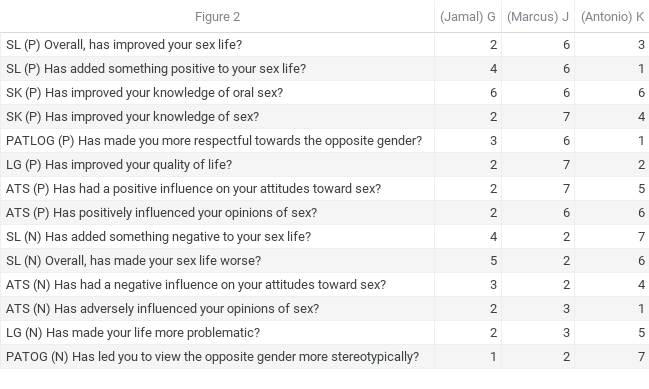
Figure 1 represents the respondents answers to the Short Form Pornography Consumption Effects Scale. This graph was used to show trends of use between the participants. The graph is split between the positive effect dimension and negative effect dimension (Noted by P and N). Jamal showed a consistent response rate with both positive and negative effects appearing in moderation with the highest rating being 6/7. Marcus had a much higher response rate to the positive effect dimension over negative effects. Antonio has a very spread response with very large impacts in both the positive and negative dimensions. Some data overlaps within figure 1, reference figure 2 for more detail.
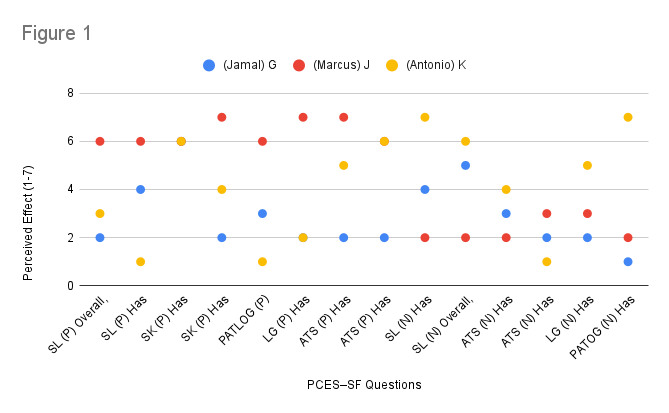
Figure 2 is a table chart showing the respondents’ answers and lists the full questions cut by Figure 1 from left to right (top to bottom respectively).
Discussion
Within the public, pornography has a wide variety of topical discussion. Ranging from gender, political, and economic issues the topic of pornography has many conflicting voices. These conflicts are understandable given the variety of results of pornography use and the outliers of addiction which might be used as a scare factor of those more staunchly against the use of pornography. In this section the researcher will lay out both the negative and positive argument for pornography and why a balanced approach is advised.
For those against pornography the literature may be seemingly within their favor. There are samples of individuals being addicted to pornography making the activity akin to heavy social media use, gambling, and other highly pertinent activities. The literature has also shown to have a negative effect on familial and interpersonal relationships with pornography use. In familial relationships, pornography use by the children showed to decay the bond between parents which would not be good for adolescent development. In interpersonal relationships (those dating), pornography has had correlation in those bonds being broken between the two individuals. On the marriage side, some wives have seen their husband’s pornography use as a threat to the stability of the marriage. Within the population of Chinese adults, another set of researchers found that “Higher levels of shared pornography use with a partner during sex strengthened the…negative attitudes toward condom use” (Wu and Zheng 1337). This goes to show that even if pornography did not have negative psychological effects there still is a sociology perspective in which one can still be against pornography. Lastly, problematic pornography use also had a negative effect on sexual function (Berger et al.). Within the study of this paper the researcher has confirmed some of these effects and more. Two of the participants made very clear that their sexual lives were directly impacted because of their pornography use. Especially when both were/are sexually active at the time they reported erectile and arousal problems. One participant even noticed a change in confidence and direct perception of the opposite gender because of his use. From the Short Form Pornography Consumption Effects Scale, there were few answers that were at response of 1/7 on the negative questionnaire side meaning that all participants in one area or another had mediocre negative effects because of their pornography use. All of the preceding evidence gives a very good case to be against pornography or to at least personally cease use. This was also shown in participants surveyed - all of them wanted to completely quit their pornography use.
However, when reviewing the literature the researcher widely neglected the positive benefits of pornography use. One study, in the context of couples, found that “In the current sample of respondents, ‘no negative effects’ was the most commonly reported impact of pornography use” (Kohut et al. 585). While on the other hand “positive perceived effects of pornography use on couple members and their relationship (e.g., improved sexual communication, more sexual experimentation, enhanced sexual comfort) were reported frequently” (Kohut et al. 585). This is counter to most of the findings within the initial literature review and the experiences of this paper’s research participants. Moreover, Brajdić Vuković et al. found that women consumed pornography mostly in an effort to expand their solo and dual sexual repertoire. These results would bolster the sexual lives of women and (in consequence) men due to their pornography consumption. Lastly, one participant within this paper’s study showed that there need not be negative effects of pornography use. To all extent, the use of pornography helped the participant become more sexually competent, practice safer sex (in opposition to the Chinese study), and as a form of self-relaxer. Having no effect on his relationship, he and his partner both used pornography as entertainment and a form of bonding rather than anything directly erotic. This participant gave great insight into how pornography can be used for beneficial means.
The internet is one of the most uncensorable platforms to be created. With the existence of decentralization and proxy technology, illegal material is accessible with minimal effort. To have a staunch stance against pornography (e.g. illegality) would be a waste of effort by public and private initiatives with it’s massive use. The most optimal solution then would be to treat this as any other behavior issue since both positive and negative effects exist. Make people aware of the extremes, educate them to use caution, and let them know when to seek help and treatment. Pornography is akin to the act of gambling. Many go to Vegas not with the intention of getting addicted, they use caution and have a good time. The purpose of the sampled research was used to see if, just like YouTube, pornography users could be split into a spectra and what the self-perceived effects of their pornography use were. This result was confirmed because of a distinction was able to be made between functional and compulsive users. The topic of pornography must be a topic of discussion between parents and children because of how early the exposure window currently is. With the results, the participants did believe their use was a problem but no participant showed their use to be inherently problematic. Therefore, a balanced approach must be met when discussing and using the medium of pornography.
The scope of this research was extremely limited and there are still many areas to be explored. This paper’s study had the limitation of a small sample size and the inherent problem of self-perceived rather than actual effects. Further research could look into how pornography use more closely correlated to that of other behavioral problems such as addictive Youtube use (for where the study draws parallels too). The industry and genre of pornography is not going away any time soon. Until a more clear picture can be put on the psychological and neurological effects of pornography, viewer discretion is advised.
Work Cited
2017 Year in Review - Pornhub Insights. 9 Jan. 2017, https://www.pornhub.com/insights/2017-year-in-review.
2021 Year in Review - Pornhub Insights. https://www.pornhub.com/insights/yir-2021. Accessed 22 Mar. 2022.
Berger, Jonathan H., et al. “Survey of Sexual Function and Pornography.” Military Medicine, vol. 184, no. 11/12, Dec. 2019, pp. 731-37. EBSCOhost, https://doi.org/10.1093/milmed/usz079.
Bőthe, Beáta, et al. “Are Sexual Functioning Problems Associated with Frequent Pornography Use and/or Problematic Pornography Use? Results from a Large Community Survey Including Males and Females.” Addictive Behaviors, vol. 112, Jan. 2021, p. 106603. ScienceDirect, https://doi.org/10.1016/j.addbeh.2020.106603.
Brajdić Vuković, Marija, et al. “Može li pornografija pozitivno utjecati na žensku seksualnost? Utjecaj učestalog konzumiranja pornografije na spolni život mladih obrazovanih žena: kvalitativno istraživanje.” Revija za sociologiju, vol. 43, no. 2, Aug. 2013, pp. 133-58. hrcak.srce.hr, https://doi.org/10.5613/rzs.43.2.2.
de Alarcón, Rubén, et al. “Online Porn Addiction: What We Know and What We Don’t-A Systematic Review.” Journal of Clinical Medicine, vol. 8, no. 1, Jan. 2019, p. 91. PubMed Central, https://doi.org/10.3390/jcm8010091.
DeKeseredy, Walter, and Marilyn Corsianos. Violence against Women in Pornography. Routledge, 2015, https://doi.org/10.4324/9781315652559.
Donevan, Meghan, et al. “Adolescents’ Use of Pornography: Trends over a Ten-Year Period in Sweden.” Archives of Sexual Behavior, vol. 51, no. 2, Feb. 2022, pp. 1125-40. Springer Link, https://doi.org/10.1007/s10508-021-02084-8.
Ford, Jeffrey J., et al. “Structural Therapy With a Couple Battling Pornography Addiction.” The American Journal of Family Therapy, vol. 40, no. 4, July 2012, pp. 336-48. Taylor and Francis+NEJM, https://doi.org/10.1080/01926187.2012.685003.
Gola, Mateusz, and Marc N. Potenza. “Paroxetine Treatment of Problematic Pornography Use: A Case Series.” Journal of Behavioral Addictions, vol. 5, no. 3, Sept. 2016, p. 529. _
Kohut, Taylor, et al. “Perceived Effects of Pornography on the Couple Relationship: Initial Findings of Open-Ended, Participant-Informed, ‘Bottom-Up’ Research.” Archives of Sexual Behavior, vol. 46, no. 2, Feb. 2017, pp. 585-602. Springer Link, https://doi.org/10.1007/s10508-016-0783-6.
Manning, JillC. “The Impact of Internet Pornography on Marriage and the Family: A Review of the Research.” Sexual Addiction & Compulsivity, vol. 13, no. 2/3, Apr. 2006, pp. 131-65. EBSCOhost, https://doi.org/10.1080/10720160600870711.
Perry, Samuel L., and Joshua T. Davis. “Are Pornography Users More Likely to Experience a Romantic Breakup? Evidence from Longitudinal Data.” Sexuality & Culture, vol. 21, no. 4, Dec. 2017, pp. 1157-76. Springer Link, https://doi.org/10.1007/s12119-017-9444-8.
Perry, Samuel L., and Kara J. Snawder. “Pornography, Religion, and Parent-Child Relationship Quality.” Archives of Sexual Behavior, vol. 46, no. 6, Aug. 2017, pp. 1747-61. Springer Link, https://doi.org/10.1007/s10508-016-0927-8.
Quadara, Antonia, et al. The Effects of Pornography on Children and Young People. 2017, https://aifs.gov.au/sites/default/files/publication-documents/rr_the_effects_of_pornography_on_children_and_young_people_1.pdf.
Sniewski, Luke, et al. “The Assessment and Treatment of Adult Heterosexual Men with Self-Perceived Problematic Pornography Use: A Review.” Addictive Behaviors, vol. 77, Feb. 2018, pp. 217-24. ScienceDirect, https://doi.org/10.1016/j.addbeh.2017.10.010.
Solano, Ingrid, et al. “Pornography Consumption, Modality and Function in a Large Internet Sample.” Journal of Sex Research, vol. 57, no. 1, Jan. 2020, pp. 92-103. EBSCOhost, https://doi.org/10.1080/00224499.2018.1532488.
Twohig, Michael P., and Jesse M. Crosby. “Acceptance and Commitment Therapy as a Treatment for Problematic Internet Pornography Viewing.” Behavior Therapy, vol. 41, no. 3, Sept. 2010, pp. 285-95. PubMed, https://doi.org/10.1016/j.beth.2009.06.002.
Wu, Ting, and Yong Zheng. “Perceptions of Pornography and Attitudes Toward Condom Use in Heterosexual Chinese Adults: The Effect of Sexual Pleasure, Safer Sex Communication Apprehension, and Shared Pornography Use During Sex.” Archives of Sexual Behavior, vol. 51, no. 2, Feb. 2022, pp. 1337-50. Springer Link, https://doi.org/10.1007/s10508-021-02134-1.