2026-01-26-productivity-and-velocity
I certainly agree that working on the right thing is important, but increasing velocity doesn’t stop you from working on the right thing. If anything, each of these is a force multiplier for the other. Having strong execution skills becomes more impactful if you’re good at picking the right problem and vice versa.
Some reasons to work on productivity and velocity
Full backup
A common topic of discussion among my close friends is where the bottlenecks are in our productivity and how we can execute more quickly. This is very different from what I see in my extended social circles, where people commonly say that velocity doesn't matter. In online discussions about this, I frequently see people go a step further and assign moral valence to this, saying that it is actually bad to try to increase velocity or be more productive or work hard (see appendix for more examples). The top reasons I see people say that productivity doesn't matter (or is actually bad) fall into one of three buckets: Working on the right thing is more important than working quickly Speed at X doesn't matter because you don't spend much time doing X Thinking about productivity is bad and you should "live life" I certainly agree that working on the right thing is important, but increasing velocity doesn't stop you from working on the right thing. If anything, each of these is a force multiplier for the other. Having strong execution skills becomes more impactful if you're good at picking the right problem and vice versa. It's true that the gains from picking the right problem can be greater than the gains from having better tactical execution because the gains from picking the right problem can be unbounded, but it's also much easier to improve tactical execution and doing so also helps with picking the right problem because having faster execution lets you experiment more quickly, which helps you find the right problem. A concrete example of this is a project I worked on to quantify the machine health of the fleet. The project discovered a number of serious issues (a decent fraction of hosts were actively corrupting data or had a performance problem that would increase tail latency by > 2 orders of magnitude, or both). This was considered serious enough that a new team was created to deal with the problem. In retrospect, my first attempts at quantifying the problem were doomed and couldn't have really worked (or not in a reasonable amount of time, anyway). I spent a few weeks cranking through ideas that couldn't work and a critical part of getting to the idea that did work after "only" a few weeks was being able to quickly try out and discard ideas that didn't work. In part of a previous post, I described how long a tiny part of that process took and multiple people objected to that being impossibly fast in internet comments. I find this a bit funny since I'm not a naturally quick programmer. Learning to program was a real struggle for me and I was pretty slow at it for a long time (and I still am in aspects that I haven't practiced). My "one weird trick" is that I've explicitly worked on speeding up things that I do frequently and most people have not. I view the situation as somewhat analogous to sports before people really trained. For a long time, many athletes didn't seriously train, and then once people started trying to train, the training was often misguided by modern standards. For example, if you read commentary on baseball from the 70s, you'll see people saying that baseball players shouldn't weight train because it will make them "muscle bound" (many people thought that weight lifting would lead to "too much" bulk, causing people to be slower, have less explosive power, and be less agile). But today, players get a huge advantage from using performance-enhancing drugs that increase their muscle-bound-ness, which implies that players could not get too "muscle bound" from weight training alone. An analogous comment to one discussed above would be saying that athletes shouldn't worry about power/strength and should increase their skill, but power increases returns to skill and vice versa. Coming back to programming, if you explicitly practice and train and almost no one else does, you'll be able to do things relatively quickly compared to most people even if, like me, you don't have much talent for programming and getting started at all was a real struggle. Of course, there's always going to be someone more talented out there who's executing faster after having spent less time improving. But, luckily for me, relatively few people seriously attempt to improve, so I'm able to do ok. Anyway, despite operating at a rate that some internet commenters thought was impossible, it took me weeks of dead ends to find something that worked. If I was doing things at a speed that people thought was normal, I suspect it would've taken long enough to find a feasible solution that I would've dropped the problem after spending maybe one or two quarters on it. The number of plausible-ish seeming dead ends was probably not unrelated to why the problem was still an open problem despite being a critical issue for years. Of course, someone who's better at having ideas than me could've solved the problem without the dead ends, but as we discussed earlier, it's fairly easy to find low hanging fruit on "execution speed" and not so easy to find low hanging fruit on "having better ideas". However, it's possible to, to a limited extent, simulate someone who has better ideas than me by being able to quickly try out and discard ideas (I also work on having better ideas, but I think it makes sense to go after the easier high ROI wins that are available as well). Being able to try out ideas quickly also improves the rate at which I...2026-01-26-weather
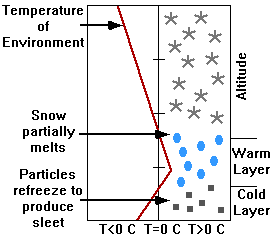
Now we see a different temperature profile. The air is colder than 0 deg C aloft where snow forms, but then warms to just above freezing in a small layer. In this layer, the falling snow partially melts so that the precipitation is now partly snow and partly water. As it continues to fall toward the surface where cold air again exists (temperature below freezing), the precipitation refreezes to form sleet or ice pellets.
Digital Dynamite
I have around 3 Megabytes (Mb) of text. To put that into equivalence 1Mb is equaly to roughly 150,000 words. So in total, my notes account for around 450,000 words. I utilize a bullet notes similar to that of Logseq but they are organizaed in a way that make sense to only myself and was not meant for public viewing.
While I have experimented with some projects such as Quarts which publishes Obsidian files from Markdwon there was one obvious glaring issue faced. I do not utilize network graphing - the ability to connect words and ideas of notes to each other. If I were to publish an online version of my notes not only would they be roughly comprehensible to most readers, a lot of the notes are only useful to myself or would have to go massive reformatting to be useful to other people.
The reason I decided to go with a blog style website is because all of my post, assets, and images can be self-contained without connecting them.
Networked Though is “a network of interconnected ideas and thoughts, clustered by how they are associated with each other. However, overtime as more and more ideas grow it just becomes a mess. Every time you mention something you have to remember to connect it to another note. While that may be great and all if I’m trying to make a highly interactive website. But that’s not why this site was made.
This site was made to provide value to other people with the ideas that I collect and the creations that I make.
This is also in the same vein of why I dislike a slow movement away from forums, there is limited accessability to public information.
So much content is either in a walled garden like Facebook, or written on the equivalent of self-destroying paper.
I grew up on a UBB based forum that has archives back to 1998 or so. You can search everything. It’s mind-blowing how you have an easier time finding stuff from 1998 than 2018 (which will invariably be accessible via some hip AJAX framework that dynamically paints content onto the page, 10 posts at a time, before eventually crashing). From Reddit
For example, one of the easist explinations I found of How does water get to the top of tall trees? was from the MadSci Network Archive back in 1997.
I fully uphold the preservation of data because it may be useful to someone now or in the future if they find it. I’ve had someone from highschool reach out to me to get the program download for the Architecture software that I used. Because I had a backup I was able to easily give it over.
I can name countless other examples of this phenomenon but the biggest one I’ve seen is the current migration to discord due to their large file upload limits and essentially being used as an archive. For example:
- The Battlefield 2 Refractor 2 Modding community moving from https://bfeditor.org/ to Discord
- Almost all gaming communities moving from Skype to Discord/Team (skype wasn’t any better either for saving data, but people used Skype)
- Most companies having a 90 day expiration policy to prevent Standard-Operating-Procedures being in chat channels and actually being documented unlike discord
- Most of my messages from the past 5 years being on Discord
- There is already a Discord Chat Exporter that was made because of this problem
Documents are documents. Books are books, recordings are recordings, and so on. As time has gone on, though, I’ve observed the probably obvious-to-others fact that Lore is the grease between the concrete blocks of knowledge, the carved step in an otherwise impossible-to-scale mountain, the small bit of powder sprinkled through a workspace to ensure sparks don’t fly and things don’t burn. Inconceivably odd to the outsider, but vital to the dedicated or intense practice of the craft. ASCII by Jason Scott, Discord, or the Death of Lore — March 6, 2023
Think of lore as the one issue only a single other person or tiny group has solved. How can you add an additional contribution without re-solving the entire equation? You can’t. It would take more time, effort, and money to do so.
Am I a hypocrite?
I would hope not. the internet still exist to connect ideas. Why else would I be linking other articles for you to explore. If I care enough about that source I archive it for myself because data and storage is extremely cheap compared to the price of not having that information. I link these other post to give context behind my logical and why I hold this stance. Even if none of these post were active anymore there are countless other examples of information being lost to time due to bad practices. An easy one being the Rosetta Stone.
Photo by Elisha Terada on Unsplash
Survivial Spleef Arena V3 for Minecraft
Download my Spleef V3 litematic – Spleef V3 Download
Features
- Many custimizable modes to play with
- Anolog score keeper
- Automatic Reset Build
Download the inspiration Spleef V2 litematic – Spleef V2 Download